



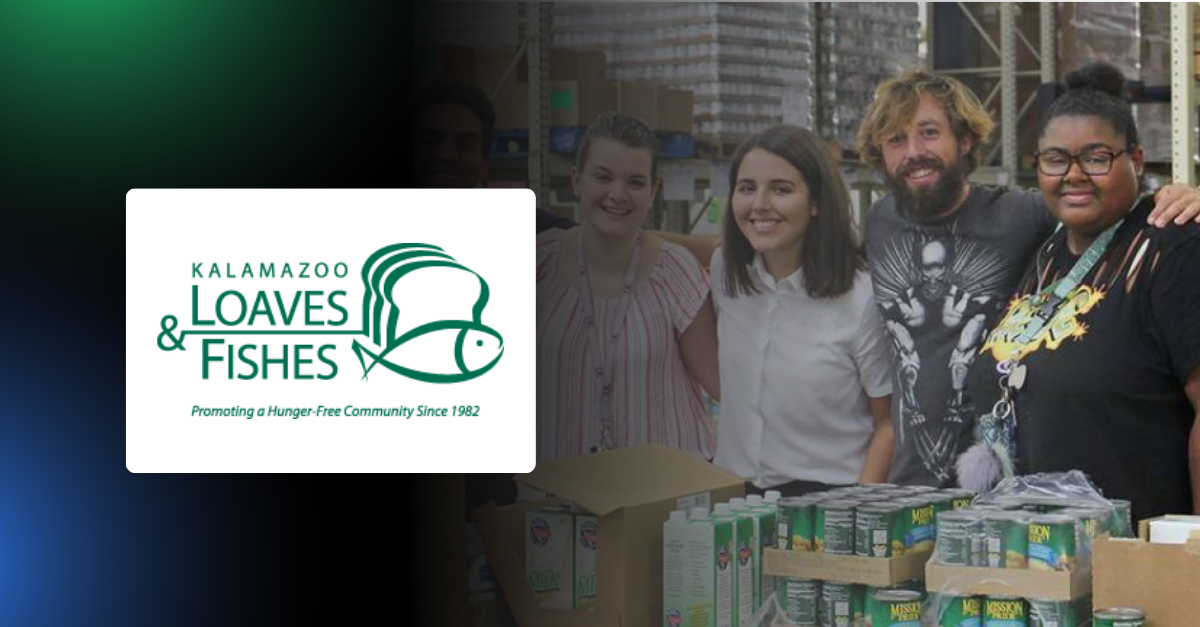
Kalamazoo Loaves & Fishes partnered with SPARK Business Works to rescue a mission-critical Microsoft Dynamics 365 database that had become too fragile to touch and lay the groundwork for a new system to continue their decades of work in hunger relief in Kalamazoo, Michigan.
A Mission That Doesn’t Slow Down
Every day, Kalamazoo Loaves & Fishes (KLF) serves an average of 850 to 950 individuals, ensuring they have groceries for themselves and their families. That happens across nine pantry locations where clients call in to make appointments, plus a home delivery program for people who can’t get to a site at all.
Since 1982, KLF has been a community staple. Recently, they’ve grown their network of partnerships to 111 distribution sites throughout Kalamazoo County, including school-based pantries, weekend food packs, and 13 mobile food distributions. The organization also runs a USDA Commodity Supplemental Food Program for seniors 60 and older.
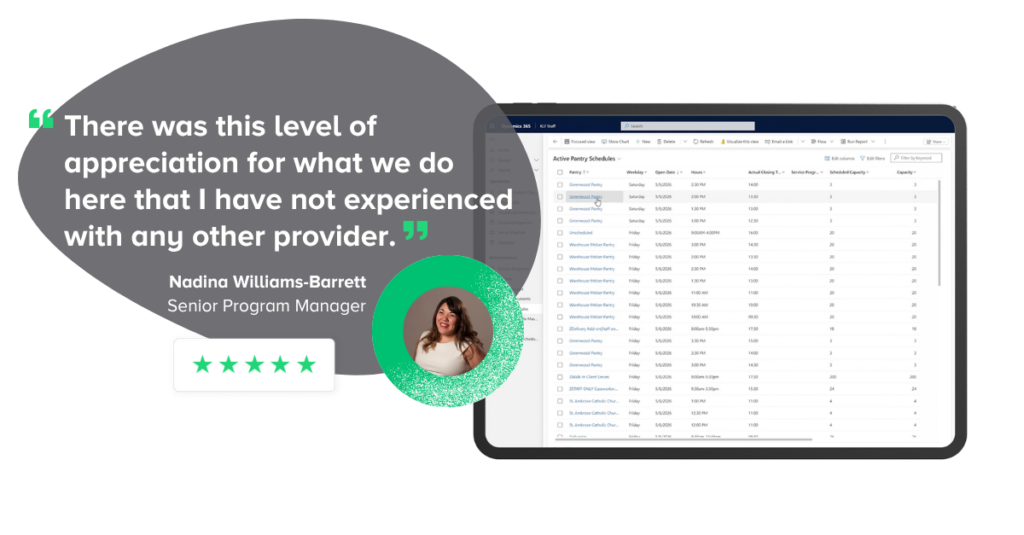
“We just did over 200,000 food orders this last fiscal year, which is a record for our agency,” says Nadina Williams-Barrett, Senior Program Manager at KLF. “It speaks to the power of the community, and it’s going to take the whole community to lift each other up.”
KLF operates as a self-declaration of need agency, meaning there’s no income or identification screening required.
“We truly believe that if you call and say you need food, that’s the truth, and we’re going to honor that and provide food that makes sense for your family,” Nadina explains.
But like most nonprofits, KLF runs on critical technology that almost no one outside the building ever notices, until it breaks. When a scheduling system glitches or a report won’t run, clients wait longer for groceries, volunteers get turned away from the one task they came to do, and staff is forced to scramble.
That’s why the technology behind KLF’s mission can’t afford to be an afterthought.
A Messy Database Nobody Could Explain
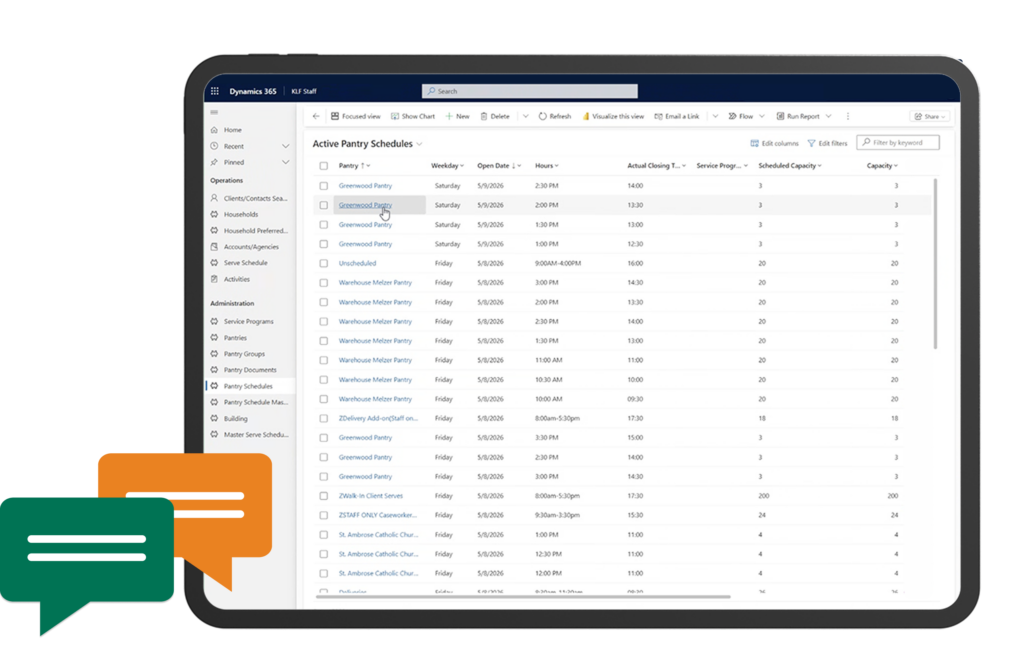
In 2020, KLF’s team built a Microsoft Dynamics 365 database with a vendor to manage client scheduling and programs. At first, the database served the team well. But over the years, it slowly became more burdensome to operate and update with new features to meet their growing needs.
One main challenge was that endless business rules were scattered across the system with no documentation to explain how any of it fit together.
When SPARK stepped in to help rescue the platform, the first job wasn’t adding new features. It was figuring out what was already there.
“The reality was, once the team got into the back end of the database, it was a tangled mess,” Nadina recalls. “When the SPARK team went to do an update for a new feature, it would break different parts of the database that no one knew were tied to it.”
“We really spent the first probably four months trial and erroring what was going to break and what was not going to break once we did updates,” she says.
Over those initial months, SPARK’s team focused on:
- Documenting the custom Dynamics schema from scratch, since nothing existed before
- Rebuilding the sandbox environment to mirror production
- Fixing capacity and scheduling bugs, including overbooking issues and staff/volunteer permission conflicts
- Putting the infrastructure in place to make future changes safely

Turning Complicated Processes Into Easy Ones that Volunteers Can Run
Once the system was stable, SPARK turned to KLF’s biggest daily pain point: scheduling.
“Historically, the organization was same-day appointments,” Nadina explains. “If you couldn’t get an appointment that same day, you were just kind of out of luck and had to call back the next day.”
KLF’s team had built a workaround inside Dynamics to schedule visits in advance, but it only worked for staff.
“It was a 12-step process, and only staff could do it,” Nadina says. “So every time a volunteer got a call from someone who said, ‘I only have Thursday off, can I schedule now?’ they had to transfer it to a staff member. It was such a huge burden on the staff. It was time-consuming for the client because they had to wait on hold, and it was really demoralizing to the volunteers, because they’re coming in to help and they couldn’t do the one function they needed to do to help someone.”
SPARK rebuilt the scheduling function so volunteers could book advance appointments themselves, and no longer wait for staff.
“Now our volunteers can do it, and they feel like they have purpose again because they’re not having to transfer calls to staff members,” Nadina says. “My team has a huge weight off their shoulders because they don’t have a call log of ten people waiting for them.”
From a 27-Step Pull to One Click for Client Lookup
Some of KLF’s nine pantry locations are staffed by volunteers in the evening, after the main call center closes for the day. Those sites still needed to know, in real time, whether a walk-in client had already been served elsewhere.
Before SPARK’s fix, pulling that information meant aggregating data for every client in the database, which took considerable time.
“Previously, it was a 27-step process to pull that information out of our database,” Nadina says. “Now it’s literally one click. My team can send that report, and our pantry sites can open it up, and they’re functioning. Ease of use has been the name of the game.”
A Partnership That Shows Up
For Nadina and KLF, the technical wins are only half the story. What’s kept her confident in the process is how SPARK’s team communicates.
“I’ve never been left hanging at any point,” she says. “Anytime I’ve had an issue, or something randomly goes down, I’ve had a response from the team within minutes.”
“It’s truly a partnership,” Nadina adds. “I feel like the team truly understands what our mission is, values it, and believes in the work that we’re doing.”
That trust is also why SPARK’s next recommendation landed the way it did. Rather than continuing to patch a system built on outdated rules, SPARK brought KLF a different option entirely: building a new custom database.
“I was super thankful when they proposed taking on a custom database for us,” Nadina says. “That’s not something we had really broached. They had the forethought to lay out the choice for us: keep spending money to make Dynamics workable, or put that money toward something that would take us into the future. They brought solutions to the table without us even having to ask.”
What’s Next: A Custom Database Built for Decades to Come
Recognizing the need for a platform to serve KLF well into the future, SPARK is migrating all of KLF’s existing scheduling and client data into the new system while building it around how KLF’s staff and volunteers actually work, not around what a pre-built platform allows.
“A lot of our volunteers are retired, and they’re giving their time and talents,” Nadina says. “Having a database that’s easy and intuitive, where they know where they’re supposed to go next, is a top priority in this new system.”
The new portal will include:
- Online self-scheduling for clients, synced to their existing accounts
- Text reminders before appointments to help cut down no-shows
- A simpler, role-aware experience for staff and volunteers
- Digital intake forms and automated reporting, built in from the start
- Automation for KLF’s federal senior food program
Nadina is especially focused on what self-scheduling will mean for the clients KLF serves.
“The thing I’m most excited about is letting clients self-schedule,” she says. “They’ll be able to schedule online, pick a location and time that works best for them, and get text reminders before their appointment. We’re hoping that extra layer of communication helps us reach clients working second and third shift who can’t call us when we’re open, but still need our services.”
SPARK is grateful for the rewarding experience of partnering with an organization that’s integral to ending hunger in our local Michigan community.
Visit Kalamazoo Loaves and Fishes at www.kzoolf.org to learn more about their mission and services.
See the full project breakdown in the Kalamazoo Loaves & Fishes case study.
Is your organization stuck with outdated software that’s holding back your growth? Reach out to the SPARK team today!